Sometimes life does not feel overwhelming because everything is falling apart.
Sometimes it feels overwhelming because too many small things have been left unfinished.
The laundry waiting in the corner.
The clutter on the table.
The messages you still need to answer.
The thoughts you have not had time to sort through.
The worries you keep carrying from one day into the next.
The week can slowly pile up around you — not only in your home, but in your mind and heart too.
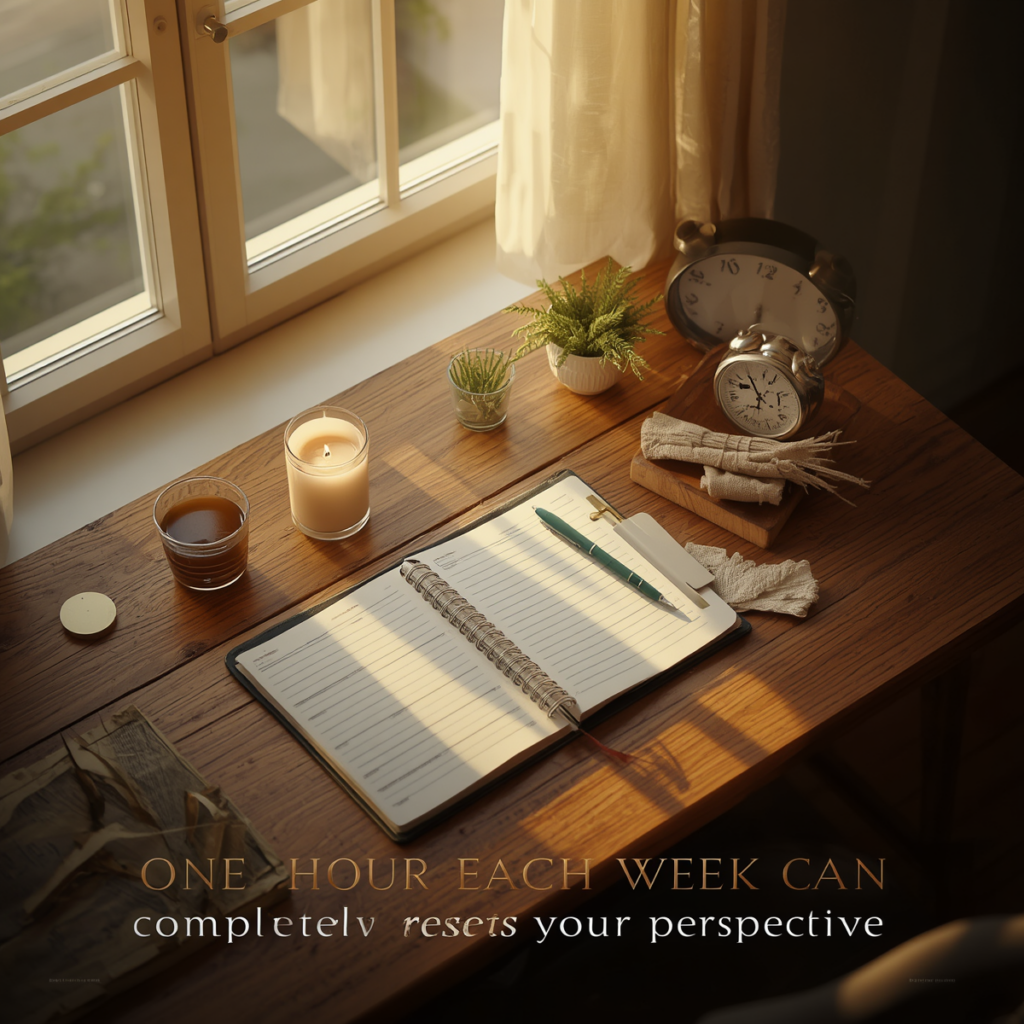
That is why one quiet hour each week can make such a difference.
Not an entire day.
Not a perfect routine.
Not a complete life makeover.
Just one hour.
One hour to pause.
One hour to breathe.
One hour to clear a small space.
One hour to notice what you are carrying.
One hour to prepare for the week ahead with a calmer mind.
A weekly reset is not about becoming a perfect person.
It is about giving yourself a gentle chance to begin again.
Why One Hour Can Help
Many people wait until everything feels chaotic before they slow down.
They wait until the house is too messy.
The schedule is too full.
The emotions are too heavy.
The mind is too tired.
But a weekly reset gives you a small moment to return to yourself before the pressure becomes too much.
One hour can help you see what matters.
It can help you separate real priorities from mental noise.
It can remind you that not everything needs to be solved today.
Sometimes a little structure creates a lot of peace.
When your space feels clearer, your thoughts may feel lighter.
When your thoughts are written down, they may feel less scary.
When you pause to be grateful, the week may not look as heavy as it did before.
When you plan gently, the next few days may feel less overwhelming.
The point is not to control every detail of your life.
The point is to stop carrying everything in your head.
The Weekly Reset Hour
This simple routine is divided into four parts.
Each part takes about 15 minutes.
You can do it on Sunday evening, Monday morning, Friday afternoon, or any time that feels peaceful for you.
The day does not matter as much as the intention.
For one hour, you are not trying to fix your whole life.
You are simply creating space for clarity, reflection, gratitude, and a fresh start.
First 15 Minutes: Reset Your Space
Start with your physical space.
Choose one small area.
Not the whole house.
Not every room.
Just one area that has been quietly bothering you.
It could be your desk.
Your kitchen counter.
Your nightstand.
Your bathroom sink.
Your bag.
Your car seat.
Your laundry chair.
Your coffee table.
Set a timer for 15 minutes and do only what you can within that time.
Throw away trash.
Put items back where they belong.
Fold one small pile of clothes.
Wipe one surface.
Clear the space where you begin your morning.
Make the area feel a little lighter.
This part matters because clutter often carries emotional weight.
A messy space can make your mind feel scattered, even when you are trying to relax.
You do not need your home to look perfect.
You only need one area to feel calmer than it did before.
When the timer ends, stop.
Even if everything is not finished, you have still made progress.
The goal is not perfection.
The goal is relief.
Ask yourself:
What small space would make me feel lighter if I reset it today?
Then begin there.
Second 15 Minutes: Write Down What Is Worrying You
After clearing a small space, clear a small part of your mind.
Take a notebook, a piece of paper, or the notes app on your phone.
Write down everything that has been sitting in your thoughts.
Do not organize it at first.
Do not make it pretty.
Do not worry about grammar.
Just write.
The bills.
The appointment.
The conversation you are avoiding.
The person you are worried about.
The task you keep delaying.
The decision you do not want to make.
The thing you wish you had handled differently.
The emotion you have not had time to admit.
Sometimes the mind feels heavy because it is trying to hold too much at once.
Writing things down does not solve everything immediately.
But it moves the weight out of your head and onto the page.
Once it is on paper, you can look at it more clearly.
After writing your list, divide it into three simple groups:
Things I can do.
Things I cannot control.
Things I need to release for now.
This step is powerful because not every worry deserves the same response.
Some worries need action.
Some need patience.
Some need prayer.
Some need a boundary.
Some need to be put down because they were never yours to carry.
Ask yourself:
What has been taking up too much space in my mind this week?
Write it down.
Then decide what actually needs your attention.
Third 15 Minutes: Reflect And Practice Gratitude
The next part of your weekly reset is reflection.
This is where you look back before moving forward.
Many people finish a week and immediately rush into the next one without ever asking what the week taught them.
But reflection helps you notice what you might otherwise miss.
Ask yourself a few gentle questions:
What went well this week?
What felt heavy?
What did I learn?
What drained me?
What gave me peace?
What do I want to do differently next week?
You do not need long answers.
Even one sentence is enough.
Then write down three things you are grateful for.
They do not have to be huge.
A warm meal.
A phone call.
A quiet morning.
A safe drive.
A pet beside you.
A problem that did not become worse.
A person who checked on you.
A moment when you laughed.
A day you survived even though it was hard.
Gratitude does not mean pretending life is perfect.
It means allowing your heart to notice that even in an imperfect week, something good was still present.
This part of the reset can soften your perspective.
It can remind you that the week was not only stress.
It had moments of grace too.
Ask yourself:
What is one small thing from this week that I do not want to overlook?
Write it down.
Let it count.
Final 15 Minutes: Prepare For The Week Ahead
The last part of your weekly reset is gentle planning.
Not strict planning.
Not overwhelming planning.
Gentle planning.
Look at the week ahead and choose only a few things that truly matter.
Start with three priorities.
Not ten.
Not twenty.
Three.
Ask yourself:
What are the three most important things I need to focus on this week?
Then choose one thing you can do for your body.
Maybe drinking more water.
Taking a walk.
Going to bed earlier.
Making one simple meal.
Stretching for five minutes.
Resting without guilt.
Then choose one thing you can do for your heart.
Maybe calling someone you miss.
Writing in a journal.
Spending a few quiet minutes in prayer.
Forgiving yourself for something small.
Letting go of a conversation you keep replaying.
Then choose one thing you need to release before the new week begins.
A worry.
A mistake.
A comparison.
A grudge.
A fear.
A pressure to be perfect.
This final step helps you enter the new week with intention instead of panic.
You are not trying to control everything.
You are simply choosing how you want to show up.
A Simple Weekly Reset Template
If you want to keep it easy, use this structure:
15 minutes to reset one small space.
15 minutes to write down what is worrying you.
15 minutes to reflect and write three things you are grateful for.
15 minutes to prepare for the week ahead.
That is it.
One hour.
Four small steps.
A little less clutter.
A little more clarity.
A little more gratitude.
A little more peace.
What To Remember
A weekly reset does not need to look beautiful.
It does not need candles, perfect notebooks, matching baskets, or a spotless home.
Those things can be nice, but they are not the point.
The point is to pause long enough to notice what you need.
Maybe you need rest.
Maybe you need a plan.
Maybe you need to stop avoiding one task.
Maybe you need to forgive yourself for not doing everything.
Maybe you need to clear one surface so your morning feels lighter.
Maybe you need to write down the worry you keep carrying alone.
Maybe you need to remember that one hard week does not define your whole life.
The reset is not about fixing everything.
It is about creating enough space to breathe.
One Hour Can Change The Way You See The Week
You may not be able to change everything about your life in one hour.
But you can change the way you enter the next week.
You can enter it with a clearer desk.
A calmer mind.
A lighter heart.
A shorter list.
A few honest priorities.
A little gratitude.
A small sense of direction.
And sometimes, that is enough to shift your perspective.
One hour each week can remind you that your life is not only a list of things to finish.
It is also something you are allowed to tend gently.
Your space matters.
Your mind matters.
Your heart matters.
Your peace matters.
So choose one hour this week.
Clear one space.
Write one worry.
Name one blessing.
Plan one gentle step forward.
You do not have to reset your whole life.
You only have to begin with one quiet hour.
