a young nun who lived quietly in a cloistered convent and died at just 24 years old, yet more than a century later, millions of people around the world still believe they have received blessings through her intercession.
There are lives that, while they are being lived, seem very small.
No glory. No crowds. No distant journeys, no powerful sermons, no great achievements that capture the world’s attention.
Just a small room in a convent. A simple brown habit. A body gradually weakened by tuberculosis. Long nights of coughing. Quiet prayers. Small tasks repeated day after day. And a heart that loved God so deeply that it turned even the smallest things into an offering.
That was the life of Saint Thérèse of the Child Jesus.
She was born in 1873 in Alençon, France, into a devout Catholic family. Her birth name was Marie Françoise-Thérèse Martin. Later, the world would come to know her by a more beloved name: Thérèse of the Child Jesus, or Thérèse of Lisieux.
To ordinary eyes, Thérèse did not seem to have a life story that was particularly long or extraordinary.
She did not live to old age. She did not found a religious order. She did not travel to distant lands as a missionary. She never stood before kings. She did not build churches. She did not lead a great movement during her lifetime. She entered the Carmelite Order at a very young age, lived in the cloistered convent at Lisieux, carried out the ordinary duties of a nun, and died of tuberculosis in 1897 at just twenty-four years old.
A young nun died in a cloistered convent.
At the time, few would have imagined that the name Thérèse would ever extend beyond those convent walls.
No one imagined that a quiet, frail, often-sick young woman would become one of the most beloved saints in the Catholic Church.
No one imagined that her spiritual writings, later known as The Story of a Soul, would touch millions of hearts.
And even fewer could have imagined that more than a century later, countless believers would still ask for Saint Thérèse’s intercession, still share stories of graces received, signs given, and roses appearing at just the right moment—as gentle reminders that heaven is not far away.
But to understand why a young nun who died at twenty-four could have such a profound impact, we must begin with the smallest thing in her life.
Thérèse did not seek greatness the way the world usually defines it.
From childhood, she was sensitive, affectionate, and deeply emotional. She lost her mother at a very young age, and that loss left a deep wound in her heart. Yet in that very fragility, she gradually learned to cling to God the way a child clings to a father.
She did not come to God with the pride of someone trying to prove her strength.
She came to God through littleness.
Thérèse understood that not everyone can do great things. Not everyone can make heroic sacrifices. Not everyone can become a missionary, a theologian, a martyr, or a well-known figure in the Church.
But everyone can love.
Everyone can offer God a small act.
A smile when misunderstood. A prayer while suffering. Patience when treated unfairly. A quiet task that receives no praise. A hidden sacrifice seen only by God.
From this understanding, Thérèse’s “Little Way” was born.
It was not the path of great deeds performed before the eyes of others. It was the path of love in the most ordinary things.
Thérèse longed to become a missionary. She wanted to travel far and preach the Gospel. She wanted to do great things for God. But her frail health and her vocation to the cloistered life prevented her from entering the world in the way she desired.
So what did she do?
She turned her convent into her mission field.
She prayed for priests. She prayed for sinners. She prayed for souls far from God. She prayed for people she would never meet. She offered every pain, every misunderstanding, every small task of the day to God.
For Thérèse, sweeping the floor could be an act of love. Washing clothes could be an act of love. Remaining silent after hearing a hurtful remark could be an act of love. Picking up a needle from the floor could become something great if done for God.
That is precisely what makes Thérèse so relatable to so many people.
Because most of us do not live extraordinary lives.
We do not stand on grand stages. Our names are not written into history books. We do not do things that earn the applause of the world. We live in kitchens, offices, hospitals, homes, and in days that often feel repetitive and exhausting.
We care for loved ones. We work to pay bills. We raise children. We endure illness. We forgive those who hurt us. We try to pray even when our hearts feel dry. We force a smile when no one knows we have just been crying.
And Thérèse tells us that it is precisely there that holiness is possible.
No need to do great things.
Only small things with great love.
Yet Thérèse’s life was not merely a gentle story. It was also a painful journey.
In her final years, tuberculosis ravaged her body. Coughing up blood, intense pain, exhaustion, and difficulty breathing turned every day into a battle. She did not die in the romanticized glow of a saintly legend. She died in real suffering.
There were times when her soul passed through a dark night of faith. She did not always feel sweet consolation. Prayer was not always easy. Heaven did not always seem near. Thérèse endured a profound interior trial in which she chose to believe even when she could no longer feel anything.
That makes her even more relatable.
Because many people have been there too.
They have prayed and encountered silence.
They have suffered and wondered where God was.
They have wanted to believe but felt spiritually dry.
They have done good and gone misunderstood.
They have loved and been wounded.
Thérèse did not offer a cold answer. She never claimed that faith would remove suffering. She never said that faith exists without darkness.
She simply lived as a witness that even in darkness, we can still place our small hand into God’s hand.
In 1897, as tuberculosis advanced, Thérèse knew her earthly life was coming to an end. Yet remarkably, she did not see death as an ending. She believed that after going to God, she would continue loving, continue praying, and continue helping souls still journeying on earth.
Before she died, she said something that generations of believers would never forget.
She wanted to continue doing good on earth after she entered heaven.
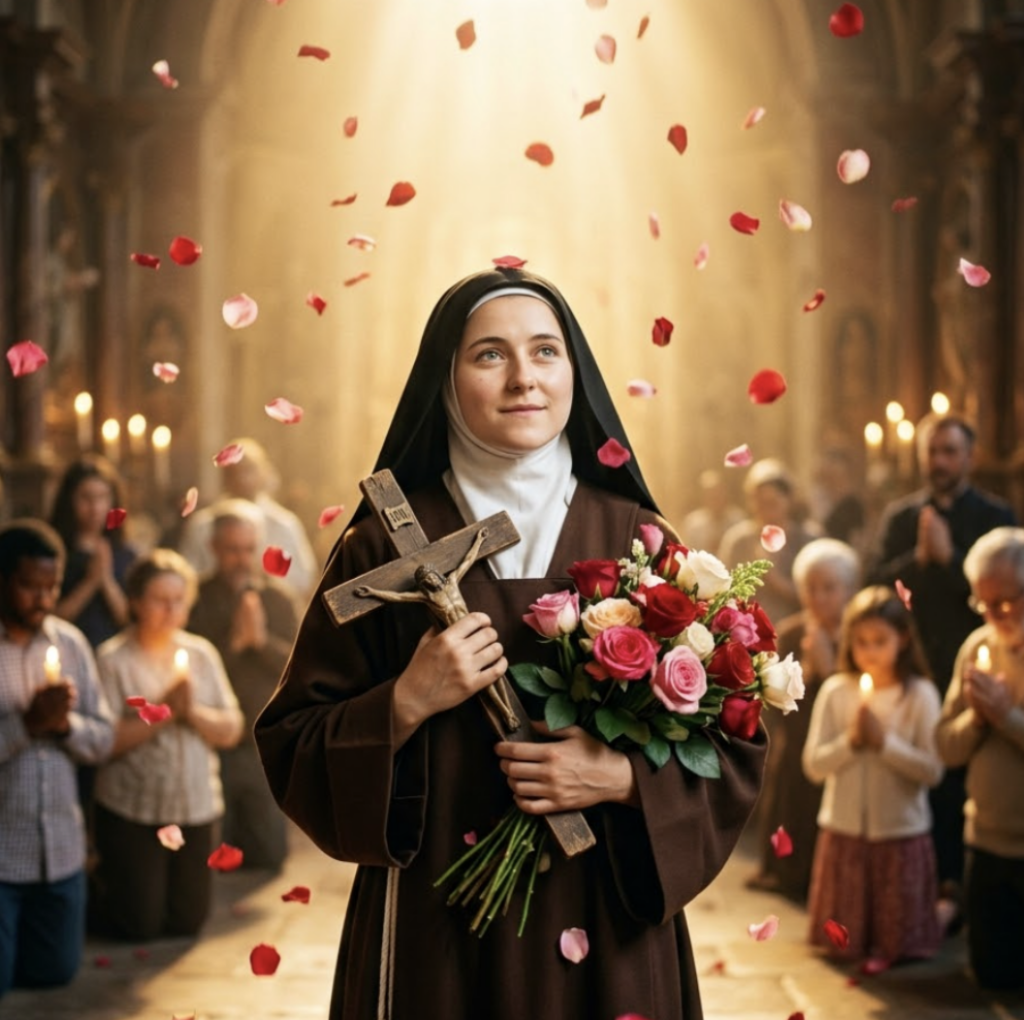
Popular devotion remembers that promise through a beautiful image: Thérèse would let fall upon the earth “a shower of roses.”
Roses.
Not gold.
Not power.
Not dramatic signs.
But roses—the symbol of love, gentleness, comfort, and quiet presence.
After her death, stories began to spread.
Someone prayed to her in a moment of despair and unexpectedly received a rose from a stranger.
Someone asked for a sign before making an important decision and then encountered roses in the most unexpected places.
Someone facing illness, losing faith, or standing at a crossroads prayed to Saint Thérèse and later spoke of receiving peace, healing, or an opportunity that seemed impossible.
Of course, not every story has been officially recognized by the Church as a miracle. In the life of faith, some things belong to personal devotion and private experiences between a soul and God. Yet these testimonies helped devotion to Saint Thérèse spread rapidly.
A young nun who once lived hidden behind convent walls became a spiritual friend to countless people who suffer.
People ask for her prayers when they are sick.
When families are falling apart.
When they feel lost.
When they want to rediscover faith.
When they need a small sign that God is still listening.
And in many of these stories, roses appear as a gentle whisper:
“You have not been forgotten.”
From France, devotion to Saint Thérèse spread across the world. Ordinary people loved her. Priests loved her. Missionaries loved her. Patients, the poor, the lonely, and those quietly praying for a miracle all turned to her.
What is remarkable is that the smaller she seemed, the closer people felt to her.
She does not intimidate people with greatness. She does not make anyone feel too sinful to approach. Instead, Thérèse feels like a little sister in heaven who understands human weakness, understands fearful hearts, and understands souls that want to love God but often stumble.
She teaches that God does not love only the strong.
God also loves little souls.
God does not see only great accomplishments.
He also sees hidden sacrifices that no one else notices.
God is not present only in magnificent churches.
He is also present in small kitchens, hospital beds, classrooms, workshops, the tears of a mother, and the quiet prayers of the elderly.
And perhaps that is why, more than a century later, Saint Thérèse still feels close.
She is still remembered in simple, everyday prayers.
“Saint Thérèse, please help me through this illness.”
“Saint Thérèse, please pray for my family.”
“Saint Thérèse, if this is God’s will, please give me a sign.”
“Saint Thérèse, teach me to love God through the Little Way.”
But the story of Thérèse does not end with roses.
What makes her beloved is not merely the stories of signs and wonders. More importantly, she changed the way many people understand holiness.
Before Thérèse, many believed holiness was something distant.
Something reserved for extraordinary people.
For great intellectuals.
For heroic souls.
For miracle workers.
But Thérèse showed that holiness can begin with a small soul.
A weak person can become a saint.
A person without power can love greatly.
A sick person can bear spiritual fruit.
A hidden life can still move the world after death.
And that is why her story remains a source of hope for millions.
Because if a young cloistered nun who died at twenty-four could remind the world of God through small acts of love, then our ordinary lives are not meaningless either.
A prayer no one hears still matters.
An act of forgiveness no one knows about still matters.
A day of suffering quietly offered to God still matters.
A small task done with love still matters.
Thérèse died in a convent, but her love was not buried with her.
After her death, the story of her life began to spread. People who discovered the Little Way found in it a new light. Those who prayed through her intercession spoke of graces received. Those who felt too weak to approach God suddenly realized that littleness is not an obstacle—it can be a path.
Then came the investigations into miracles.
The testimonies were documented.
Devotion spread.
And the young nun many assumed would be forgotten behind convent walls gradually became one of the most beloved spiritual figures in the Catholic world.
Yet one thing moves many people more than anything else.
While Thérèse was alive, she often felt small, limited, and incapable of doing the great things she longed to do.
She wanted to love God deeply, save souls, and travel the world for the Gospel.
But God did not give her a grand path before the eyes of the world.
He gave her a small room.
A small community.
Small tasks.
Small sacrifices.
A suffering body.
And a heart that knew how to turn everything into love.
And after her death, those very small things became a path for millions.
Some saints are remembered for the great things they accomplished during their lives.
Thérèse is loved because she showed that love does not need to be loud to be powerful.
Sometimes a rose appearing at the right moment is enough to bring a despairing soul to tears.
Sometimes a single line from a young nun’s journal is enough to lead someone back to God.
Sometimes a life that lasted only twenty-four years can continue blooming more than a hundred years later.
And that is why, whenever people speak of Saint Thérèse of the Child Jesus, they do not remember merely a saint of the past.
They remember a promise that is still alive.
A promise as gentle as a rose petal.
A promise that in heaven, love never stops working.
A promise that little souls are not forgotten by God.
A promise that the smallest act, if done with love, can become something great in God’s eyes.
And perhaps among the millions who have prayed to Saint Thérèse, many still remember clearly the moment they received their own “rose.”
Not necessarily a literal flower.
It may have been a phone call that arrived at just the right moment.
An unexpectedly positive medical result.
A loved one returning after years away.
A job opportunity opening up.
An unexplainable sense of peace.
Tears after years of spiritual dryness.
A gentle certainty in the heart that says: God is still here.
After Saint Thérèse of the Child Jesus died, life outside the convent at Lisieux initially continued as usual.
The streets remained busy. Families continued worrying about daily meals. Church bells continued to ring. The poor still sought bread. The sick still waited for comfort. Dry and weary souls continued wrestling with faith.
A young nun had died in a cloistered convent.
To many at the time, it probably seemed like an event that would change nothing.
But God often begins great things with very small seeds.
After Thérèse’s death, the Carmelite sisters preserved her spiritual writings. These pages were not intended as a literary masterpiece destined for fame. They were the honest reflections of a soul in love with God: childhood memories, her vocational journey, missionary desires, suffering, trials of faith, and above all, the Little Way—a path of complete trust in God’s love.
When those writings were published, many readers found themselves deeply moved.
They did not merely encounter a saint elevated far above them.
They found a sister.
A young soul who had known weakness, sensitivity, suffering, and spiritual darkness, yet loved God with everything she had.
Thérèse did not write to impress anyone.
She wrote as someone opening her heart before God.
That sincerity touched people deeply.
Some wept because, for the first time, they understood that their smallness did not drive God away.
Some realized they did not need to wait until they were perfect to begin loving God.
Those suffering illness found a companion in Thérèse.
Mothers, fathers, teachers, laborers, and servants suddenly understood that their ordinary lives could become places where God is present.
That is how the Little Way began to spread.
Quietly.
Without force.
Like the fragrance of a small flower.
Like a rose petal drifting softly onto a trembling hand.
What is especially remarkable is that devotion to Saint Thérèse is not reserved for scholars or theologians. Many ordinary people love her deeply. They do not need complicated theological explanations. They understand one simple truth: Thérèse teaches them how to love God in the midst of everyday life.
A poor mother can offer God the care she gives her sick child.
A hardworking father can offer God his exhausting hours of labor.
A patient can offer God his pain.
A lonely elderly person can offer God a quiet prayer.
A lost young person can begin again with one small act of love.
Thérèse did not make faith feel distant.
She brought it close.
As close as a smile.
As close as a family meal.
As close as an apology.
As close as a rose placed before a statue of Mary.
From there, stories of the “shower of roses” continued to multiply.
Someone prayed to Saint Thérèse while a family was on the verge of breaking apart. They asked for a sign if hope still remained. The next day, a neighbor unexpectedly brought over a bouquet of roses, knowing nothing about the prayer.
Someone anxiously waiting for medical results prayed for her intercession. That same day, they noticed a picture of roses in the hospital room or received a message with a rose image from an old friend. To others, it might have seemed like coincidence. To a suffering heart, it felt like comfort.
Some prayed for the conversion of their children.
Some prayed for employment.
Some prayed for peace before death.
Some prayed for the grace to forgive.
Some prayed only to know that God had not forgotten them.
And in different ways, they said they received a “rose.”
Sometimes it was a real flower.
Sometimes it was an event.
Sometimes it was peace.
Sometimes it was simply the strength to continue even when circumstances remained unchanged.
The important thing is not to reduce Saint Thérèse to a saint of unusual signs.
The deeper reality is that these signs draw people back to God.
Thérèse never wanted people to stop at the rose.
The rose is only an invitation.
An invitation to go deeper into God’s love.
An invitation to live more simply.
To trust more fully.
To become more humble.
To love through smaller things.
Over time, the Church officially recognized the holiness of Thérèse. Miracles attributed to her intercession were examined during the canonization process. She was honored not because she lived a long life, nor because she accomplished worldly greatness, but because she loved God completely through her little path.
That recognition moved many hearts.
Because it seemed as though God was telling the entire world: no life is too small when it is lived with love.
A young nun who died at twenty-four can become a great saint.
A convent room can become the starting point of a spiritual path for the whole world.
A humble journal can become a light for lost souls.
A little soul can become the companion of millions.
Later, Saint Thérèse came to be known by many affectionate titles. Many call her “The Little Flower” of God. Many see her as the saint of little souls, the saint of those seeking holiness in ordinary life. She is also especially beloved by missionaries, even though she never left her convent during her lifetime.
At first, that may sound paradoxical.
A cloistered nun becomes the patroness of missions.
But when we understand Thérèse’s life, it makes perfect sense.
She did not travel to distant lands with her feet.
She traveled through prayer.
She did not preach in crowded public squares.
She offered her small sacrifices for those who did.
She never met many souls on earth.
Yet she loved them in God.
And that reminds us that within the Church, no one is useless.
Those who pray quietly support those who labor publicly.
Those who suffer can bear fruit for missionaries.
Those who live hidden lives can contribute to the salvation of souls.
Not everyone is called to do the same work.
But everyone is called to love.
And love, united with God, can travel much farther than our feet ever could.
That is why Saint Thérèse remains beloved in so many Catholic homes.
In a small house, you may find her image beside a statue of the Blessed Virgin, with a few roses beneath it. In a church, you may see people lighting candles before her statue, whispering personal prayers. In a hospital, a mother may hold her picture while her child undergoes surgery. In a modest bedroom, an elderly person may pray with her every night.
More than a century has passed since Thérèse left this world.
Yet the world still turns to her.
Perhaps because modern people, despite living in an age of technology and speed, still long for simplicity.
We are surrounded by noise.
News, pressure, money, success, comparison, fear of failure, loneliness in the midst of crowds.
Many people feel small.
Small before illness.
Small before debt.
Small before broken families.
Small before old age.
Small before overwhelming decisions.
Small before a world that constantly demands strength, success, and visibility.
And Thérèse tells us that being small is not failure.
Being small can be a path.
When a child is small, he does not climb a high staircase alone. He reaches up for his father to carry him.
Thérèse did the same.
She did not try to climb to heaven by her own strength. She entrusted herself like a child. She trusted in God’s merciful love. She did not deny her weakness; she placed that very weakness into God’s arms.
That is a profound lesson.
Because many of us think God will love us more if we become stronger.
Better.
More prayerful.
Less flawed.
More spiritually perfect.
But Thérèse reminds us that God is Father.
He loves us not because we are perfect, but because we are His children.
That does not mean we should stop striving. Thérèse herself worked hard. But she did not place her hope in herself. She placed it in mercy.
For that reason, the Little Way is not a path of complacency.
It is a path of humility.
The courage to admit weakness.
The courage to begin again.
The courage to love through unseen acts.
The courage to believe when nothing is felt.
The courage to surrender when the future cannot be controlled.
The courage to remain little in a world that constantly demands greatness.
Perhaps that is why many elderly people love Saint Thérèse.
As old age arrives, people can no longer do what they once did. Health declines. Children build lives of their own. Simple tasks become difficult. Some begin to feel like burdens.
But Saint Thérèse reminds them that a prayer offered from a hospital bed still matters.
A Rosary prayed in loneliness still matters.
A painful day offered to God still matters.
No one is excluded from God’s love simply because they are no longer strong.
Many young people also turn to Thérèse.
They see in her someone who died young but did not waste her life. She did not wait until old age to pursue holiness. She loved God in her youth, in her dreams, in her sensitivity, and in her very real inner struggles.
Her life tells young people that youth is not only for success, romance, fame, or experiences. Youth can also be a time for holiness, for learning to love, and for choosing God with a free heart.
As for those who suffer, Thérèse does not promise that every pain will disappear.
But she offers them a friend.
A saint who understands suffering.
A soul that walked through darkness.
Someone who coughed blood through the night, endured physical decline, and battled spiritual dryness, yet still responded to God with love.
So when people pray to Thérèse, they are not only asking for outward miracles.
They are also asking for inward miracles: the grace to endure, the grace to trust, the grace not to despair.
Perhaps the greatest miracle is not always physical healing, an open door, or an impossible event suddenly happening.
Sometimes the greatest miracle is a heart that continues to believe after shedding many tears.
A person who keeps praying after repeated disappointments.
A soul that continues to love God without understanding its suffering.
A person who remains kind even when life has not been kind to them.
That too is a shower of roses.
Not always falling in the form of a red flower.
Sometimes it falls as the quiet strength to rise and face one more day.
In many Catholic families, mention Saint Thérèse and people remember personal stories.
A grandmother who prayed to her for a gravely ill grandchild.
A mother who received roses after praying for her child to return to the faith.
A father who found work just as his family was losing hope.
A patient who experienced an unexpected peace before surgery.
A suffering soul who opened a book, read a passage about the Little Way, and found the strength to continue.
These stories may never appear in official records.
But they live in family memories.
In conversations after Mass.
In prayer cards tucked inside wallets.
In dried roses pressed between the pages of prayer books.
In the quiet words: “Saint Thérèse helped me.”
And perhaps the most beautiful part is this: these stories do not make Thérèse the center instead of God.
They lead people back to God.
Because Thérèse never keeps the roses for herself.
She scatters them as signs of God’s love.
If someone receives a rose and stops at the wonder of it, they have only gone halfway.
But if that rose helps them believe that God still loves them, still hears them, and still invites them to live more faithfully, then it has fulfilled its purpose.
More than a hundred years after her death, Saint Thérèse continues doing what she most desired: loving God and helping others love Him.
Not through powerful speeches.
Not through worldly influence.
Not through fame.
But through a little way—very little, yet open to everyone.
When we look at the life of Thérèse, we may ask ourselves:
Am I overlooking the small things in my life?
Do I think my life lacks meaning because I cannot do something great?
Am I waiting for an extraordinary calling while forgetting that I can love God today through ordinary tasks?
Can I smile at someone?
Can I forgive a little more?
Can I pray for someone who is suffering?
Can I offer my pain to God?
Can I do one small thing with great love?
If so, then the Little Way is still open before us.
Not only for Thérèse.
But for everyone who seeks God in ordinary life.
And perhaps that is why the feast day of Saint Thérèse still touches so many hearts. Not merely because it honors a famous saint, but because it reminds us that in heaven there is a little sister still praying for little souls on earth.
That sister died at twenty-four.
But her love did not die at twenty-four.
It continued through time.
Through small churches.
Through hospital rooms.
Through grieving families.
Through lost hearts.
Through those who need a sign not to give up.
And sometimes it comes very gently.
Like a rose.
A rose on an altar.
A rose in a stranger’s hand.
A rose in a dream.
A rose in prayer.
A rose that may not change the whole world, but changes one person’s heart at the moment they need God most.
Saint Thérèse of the Child Jesus did not leave the world a castle, a kingdom, or a long life filled with great victories.
She left a path.
The Little Way.
The path of trust.
The path of small things.
The path of quiet love.
The path of a child resting in the Father’s arms.
And more than a century later, people are still walking that path.
Every time someone chooses to do a small thing with great love, that path shines again.
Every time a sick person offers suffering to God, that path continues.
Every time a mother prays for her child in the middle of the night, that path blooms.
Every time a lonely elderly person prays in a small room, another rose appears along that path.
Every time a sinner returns to God because of trust in His mercy, that path proves that Thérèse has never stopped “doing good on earth.”
So when we leave a heart reaction to remember Saint Thérèse’s feast day, it is not merely a gesture on social media.
It can also be a reminder to ourselves:
Be smaller.
Trust more.
Love more.
Do not underestimate hidden acts.
Do not think God notices only great accomplishments.
Do not forget that even a small flower can fill an entire room with fragrance.
And do not forget that a young nun who died at twenty-four in a cloistered convent can still become a sign of hope for millions more than a century later.
Because in God’s eyes, the length of a life does not determine the greatness of a soul.
Fame does not determine the value of a life.
And small acts, when done with great love, can bloom into roses in heaven.
CONCLUSION
Saint Thérèse of the Child Jesus did not live long, but she lived deeply.
She did not travel far, but her love reached the ends of the earth.
She did not do spectacular things, yet her life continues to echo in the hearts of millions of believers.
And the “shower of roses” people speak about is not only a story of mysterious signs. It is also an image of grace, mercy, and God’s love touching human lives through the gentlest things.
More than a hundred years have passed, yet Saint Thérèse’s Little Way remains.
Not only for religious men and women.
Not only for the perfect.
Not only for those capable of great achievements.
But for anyone who wishes to love God today through their own small tasks, small sufferings, small prayers, and small heart.
Because sometimes the smallest thing, offered with love, becomes the most beautiful rose before God.
