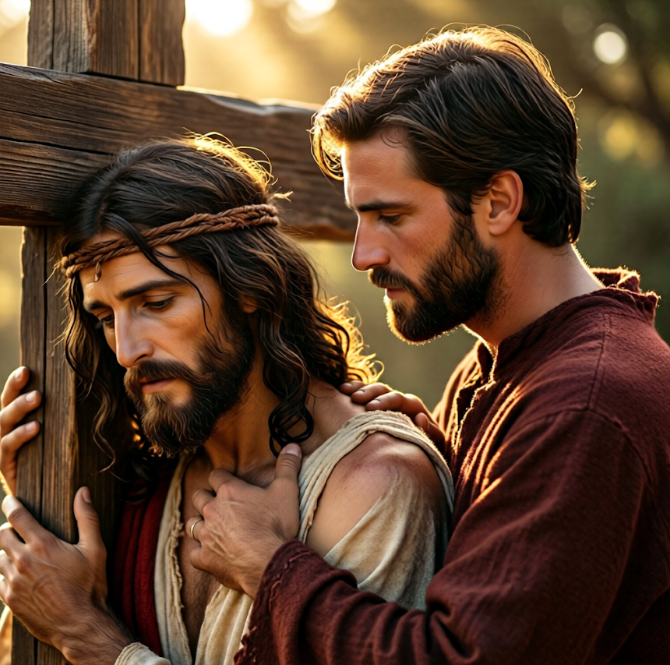
The significance of Simon of Cyrene in carrying Jesus’ cross: A deep dive into biblical history and teachings
The air in Jerusalem was thick with tension, grief, and the harsh realities of Roman occupation on that fateful Passover week. The city, usually bustling with pilgrims celebrating freedom, was instead witnessing the agonizing procession of a condemned man, Jesus of Nazareth, staggering under the immense weight of His cross. He had been scourged mercilessly, mocked, and crowned with thorns; His body was ravaged, His strength depleted, making the heavy beam an almost insurmountable burden. It was in this moment of profound weakness and suffering that a figure emerged from the crowd, an unexpected participant thrust into one of history’s most pivotal scenes: Simon of Cyrene.
His appearance is brief in the Gospel narratives, yet his role is profoundly significant, serving as a tangible link between Christ’s suffering and the human experience. The Gospels of Matthew, Mark, and Luke each recount this moment, highlighting an involuntary act that would echo through centuries of Christian faith. Simon was not a disciple, nor an enemy, but an ordinary man caught in extraordinary circumstances, compelled by Roman soldiers to share the burden that Jesus could no longer bear alone. To understand the full weight of his involvement, we must first immerse ourselves in the brutal reality of Roman crucifixion and the path Jesus walked.
Crucifixion was not merely a method of execution; it was a public spectacle designed to inflict maximum pain, humiliation, and terror. The condemned would often carry the *patibulum*, the crossbeam, from the place of judgment to the site of execution, a journey known as the Via Dolorosa, or “Way of Sorrows.” This beam alone could weigh anywhere from 75 to 125 pounds, and combined with Jesus’ physical state after scourging, sleeplessness, and the ordeal of trials, it becomes clear why His strength failed Him. The Roman soldiers, ever pragmatic and intent on maintaining order, knew that a collapse would delay the execution and potentially incite further unrest among the volatile crowd. They needed a solution, and their eyes fell upon Simon.
Simon was from Cyrene, a prominent Greek city in North Africa, located in modern-day Libya. Cyrene had a significant Jewish population, many of whom were part of the Jewish diaspora, maintaining strong ties to Jerusalem and making pilgrimages for major feasts like Passover. It is highly probable that Simon was a Jewish pilgrim, like many others, who had traveled to Jerusalem to observe the holy days. He would have arrived perhaps days or weeks earlier, joining the throng of faithful Jews, eager to participate in the ancient rituals and celebrations. His presence on the street at that precise moment was, humanly speaking, coincidental, yet from a theological perspective, it speaks volumes about divine providence.
As Jesus stumbled and faltered, the Roman soldiers, embodying the harsh efficiency of their empire, sought someone to alleviate the immediate problem. They would not tolerate a delay or an unseemly interruption to their grim task. Their gaze landed on Simon, who was likely just passing by, perhaps on his way into or out of the city, or simply observing the unfolding tragedy like many other bystanders. He was “coming in from the country,” as Mark and Luke note, suggesting he might have been working outside the city or returning from a journey, further emphasizing his unpreparedness for this sudden summons.
The Gospels describe his involvement as an act of compulsion. Matthew 27:32 states, “As they went out, they found a man of Cyrene, Simon by name. They compelled this man to carry his cross.” Mark 15:21 adds, “And they compelled a passerby, Simon of Cyrene, who was coming in from the country, the father of Alexander and Rufus, to carry his cross.” Luke 23:26 similarly records, “And as they led him away, they seized one Simon of Cyrene, who was coming in from the country, and laid on him the cross, to carry it behind Jesus.” The Greek word used, *aggareuo*, means to compel someone to perform a service, often under Roman military authority, such as pressing a civilian into service as a courier or porter. It was not an invitation or a request; it was an order, backed by the force of the Roman legionaries.
Simon, a man likely minding his own business, was suddenly snatched from anonymity and thrust into the heart of history’s most significant event. He had no choice in the matter. One moment he was a pilgrim among thousands; the next, he was sharing the burden of the Son of God, walking in the literal footsteps of Christ towards Golgotha. This involuntary act, however, transcends its immediate circumstances and carries profound theological and spiritual significance.
First, Simon’s compulsion highlights the depth of Jesus’ physical suffering. It underscores that Jesus, in His humanity, was truly broken and depleted. He was not merely enduring; He was collapsing under the weight of the wood and, more profoundly, the weight of the world’s sin that He carried spiritually. Simon’s intervention allowed the procession to continue, ensuring that Jesus reached the place of crucifixion, fulfilling the Scriptures and God’s redemptive plan.
Second, Simon of Cyrene becomes a vivid, albeit unwitting, symbol of discipleship. Jesus Himself had famously declared, “If anyone would come after me, let him deny himself and take up his cross and follow me” (Matthew 16:24). Simon literally took up Jesus’ cross and followed Him. While his act was involuntary, it serves as a powerful illustration of this foundational Christian teaching. It shows that following Christ often involves carrying burdens, enduring suffering, and walking a path that is not always chosen but is necessary. It reminds us that our crosses might not always be self-selected acts of piety but can be burdens thrust upon us by life, circumstance, or even compulsion, through which we are called to follow Christ.
Furthermore, Simon’s identity as a man from Cyrene, North Africa, underscores the universal reach of Christ’s sacrifice. He was not a Galilean, not a Judean, but an African, a member of the broader human family. His presence on that path signifies that Christ’s suffering and redemptive work were not just for the Jewish people, but for all nations, for all humanity, regardless of their origin or background. He is a harbinger of the global Church, a testament to the fact that the Gospel message would eventually spread far beyond the confines of Jerusalem.
The Gospels offer us a tantalizing hint about Simon’s potential future connection to the nascent Christian community. Mark’s Gospel, generally believed to have been written for a Roman audience, uniquely mentions Simon as “the father of Alexander and Rufus.” This detail is incredibly significant. For Mark to include the names of Simon’s sons suggests that Alexander and Rufus were known figures within the early Christian community when Mark was writing his Gospel. They were likely active members, perhaps even prominent ones, whose association with Simon would lend credibility and context to the story for Mark’s original readers. This implies that Simon’s encounter with Jesus on the Via Dolorosa was not just a passing moment but a transformative event for him and his family, leading them to embrace faith in Christ.
Imagine the encounter from Simon’s perspective: a sudden, terrifying command, the heavy, rough wood digging into his shoulder, the agonizing pace, the proximity to a condemned man whose face showed unimaginable pain and dignity. This intimate, shared suffering could not have left him unchanged. Carrying the cross behind Jesus, feeling the physical weight of that instrument of death, would have given him a unique perspective, a visceral understanding of what Christ endured. It is not difficult to conceive that this experience profoundly impacted Simon, stirring his heart and leading him and his family to become followers of the very man whose cross he was forced to carry.
This transformation, if indeed it occurred, further magnifies Simon’s significance. He moves from an unwitting bystander to a potential proto-disciple, whose forced act of service opens the door to a lifetime of willing service to Christ. His story reminds us that God often works in unexpected ways, using ordinary people and seemingly random events to fulfill His divine purpose and draw individuals into His kingdom. An unwilling burden can become the catalyst for profound spiritual awakening.
Simon’s act also offers a powerful lesson in empathy and shared burden. While his help was compelled, it relieved some of Jesus’ immediate suffering. It prompts us to reflect on our own willingness to help others carry their burdens, both literally and figuratively. In a world often characterized by individualism, Simon’s story challenges us to look beyond ourselves, to extend compassion and aid, even when it is inconvenient or goes against our immediate plans. It reminds us that Christ is present in the suffering of our neighbors, and when we help them, we are, in a sense, helping Christ Himself.
The scene of Simon carrying the cross has become a deeply ingrained part of Christian devotion, particularly in the Stations of the Cross. This ancient spiritual exercise, which traces the final journey of Jesus to Calvary, often includes “Simon of Cyrene Helps Jesus Carry the Cross” as the fifth station. Here, Simon is not just a historical figure but a participant in the profound mystery of suffering and redemption, inviting all who meditate on the Stations to consider their own role in alleviating suffering and embracing Christ’s call to discipleship. His presence in this devotional practice highlights his enduring relevance as a model of compassion and shared burden.
In contemplating Simon’s role, we are invited to consider the various ways we “carry the cross” in our own lives. This can mean enduring personal hardships with faith and perseverance, bearing witness to Christ in challenging circumstances, or even stepping in to assist others who are struggling under their own weights. Sometimes, our “cross” is not something we choose but something that is “laid upon us” by life’s circumstances, just as it was for Simon. Yet, in carrying it, particularly if we do so with an awareness of Christ’s presence and example, we find strength and purpose.
The narrative of Simon of Cyrene is also a testament to the human condition and the universal experience of suffering. In Christ’s weakest moment, He needed human aid. This does not diminish His divine power, but rather emphasizes His full humanity, His real vulnerability. And in Simon, we see the universal human capacity for both reluctant service and profound impact. He was just a man, like any of us, yet his simple, compelled act became a moment forever etched in the story of salvation.
The encounter on the Via Dolorosa speaks to the idea that no act, however small or involuntary, is insignificant in God’s grand design. Simon’s brief appearance on the stage of salvation history was orchestrated by divine providence, demonstrating that God can use anyone, at any time, in any circumstance, to advance His purposes. From a mere passerby, Simon became an indispensable figure, a silent partner in the journey to Golgotha, whose story continues to inspire and challenge believers today.
His story is not just a historical footnote; it is a living parable. It reminds us that the call to follow Christ is often found in the most unexpected places and through the most unforeseen events. It teaches us about humility, service, and the profound interconnectedness of human suffering and divine redemption. Simon of Cyrene, the ordinary man from North Africa, represents every one of us who may be called, willingly or unwillingly, to share in the burdens of life, and in doing so, to walk a little closer to Christ.
Therefore, the significance of Simon of Cyrene extends far beyond the physical act of carrying a heavy beam. It encompasses profound theological truths about discipleship, universality, divine providence, and the transformative power of proximity to Christ’s suffering. His story serves as a timeless reminder that even in moments of great distress and compulsion, God can weave individuals into the fabric of His redemptive plan, turning an involuntary act into an enduring legacy of faith and service. May we, like Simon, be ready to take up our crosses, whether chosen or laid upon us, and follow Christ wherever He leads.
